
Welcome toGeorge Bush Intercontinental Airport
Check parking availability
Reserve your parking in advance and save up to 50%.Learn moreGet through security faster
Check security wait times to make sure you will get through security with ease!Security Wait TimesPlan your ride from the airport
Find ground transportation options including bus routes, car rentals, rideshare apps, shuttles, and more.Ground Transportation


Good to know
Airport Services
IAH provides a variety of service-oriented amenities to enhance your travel experience.
Good to knowQuick links
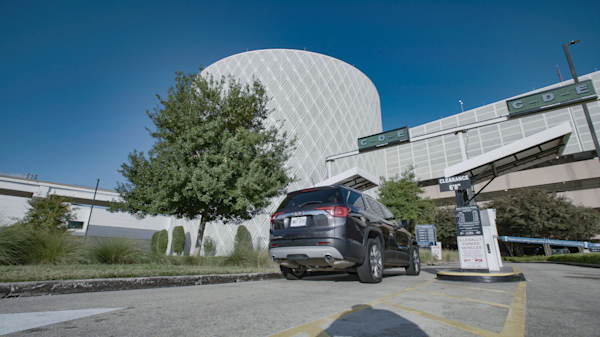
IAH Parking Information
Convenient parking is available, including reserved spots, EV charging, and accessible spaces.
Learn more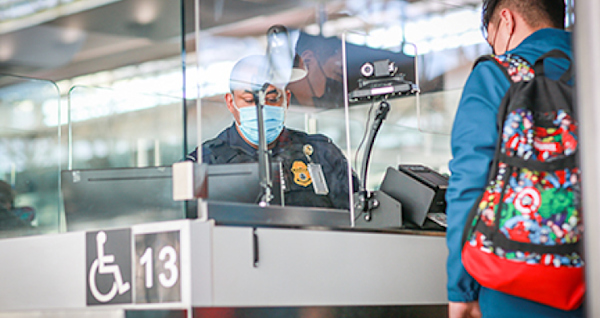
International Processing
International passengers will proceed through Customs & Immigration in the Terminal E international arrivals hall.
Learn more
Need Transportation
Choose from Rideshare apps, shuttles, or rental cars for convenient ground transportation options.
Learn more
Latest UpdatesNewsroom
View all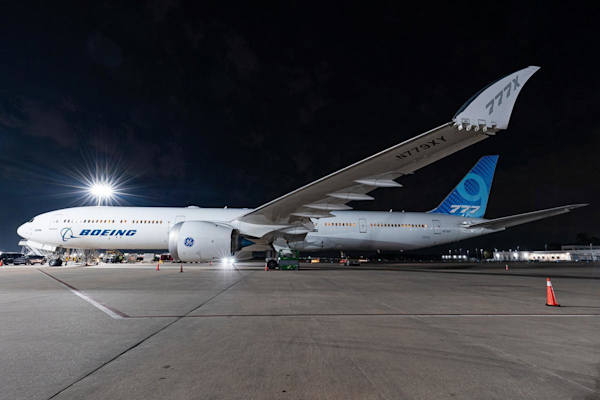 IAHNov 23, 2026
The jet that folded its wings at IAH
Most visitors arrive in Houston with luggage. This one arrived with folding wings.Just before 7 p.m. Friday, Nov. 6, a Boeing 777-9 touched down at George Bush Intercontinental Airport (IAH). It was nearly 252 feet long, powered by two of the largest jet engines ever built and capable of folding its wingtips upward like a bird settling in for the night.The aircraft stayed less than 19 hours before departing for Seattle the following afternoon.It wasn't carrying vacationers. There were no tickets to buy, no boarding announcement and no new flight route to celebrate.But the brief visit offered something more intriguing: an early look at an airplane designed to change how hundreds of passengers travel across continents and oceans.And there's a reason Houston was on its itinerary.It had just completed a visit to Bolivia, where Boeing was conducting high-altitude testing at Alcantarí International Airport near Sucre, more than 10,000 feet above sea level.Up there, the air is thinner. Aircraft engines produce less thrust, wings generate less lift and takeoffs and landings become more demanding.For engineers developing a new passenger jet, those conditions provide an important test of how the aircraft performs.The 777-9 traveled from Bolivia's Santa Cruz airport to Houston on Nov. 6, landing at IAH at approximately 6:43 p.m. The following day, it departed at 1:24 p.m. for Boeing Field in Seattle, where the manufacturer's flight-test program is based.Its appearance did not go unnoticed.A passenger aboard a nearby United Airlines flight described the unexpected encounter on Reddit."It's pretty massive! It taxied right by our 737 while we waited for the alley to clear up earlier this evening."Aviation enthusiasts also followed the aircraft's journey online, sharing flight information and photographs of the unusual visitor.And unusual it is.Wait. The wings actually fold?Yes. And there's a surprisingly practical reason.The Boeing 777X is the next generation of the popular Boeing 777 family, designed to carry more passengers over longer distances while using less fuel.Its most recognizable feature is a set of folding wingtips.With its wings fully extended, the 777-9 measures roughly 235 feet from wingtip to wingtip. That's great for flying efficiently, but it creates a problem on the ground: Many airport gates and taxiways weren't designed for an airplane quite that wide.Boeing's solution is clever.The outer 11 feet of each wing can fold upward after landing, reducing the airplane's wingspan to approximately 213 feet.Think of it as the aviation equivalent of folding in your vehicle's side mirrors before squeezing into a tight garage.The wings extend and lock into position before takeoff, giving the aircraft the aerodynamic advantages of a larger wing in flight without requiring every airport to build larger parking spaces.Then there are the engines.Each GE Aerospace GE9X engine has a front fan measuring more than 11 feet across — wider than the fuselage of a Boeing 737.That's not a typo.According to GE Aerospace, the GE9X is the largest and most powerful commercial aircraft engine ever built.It's an engineering achievement that's difficult to appreciate until you see one up close.What does that mean for passengers?The 777-9 is designed to accommodate approximately 375 to 450 passengers, depending on how an airline configures its cabin. Boeing says the aircraft can travel up to 8,000 nautical miles — roughly 9,200 statute miles — without stopping.That kind of range gives airlines greater flexibility to connect distant cities with nonstop service.Boeing also projects that the 777-9 will use approximately 20% less fuel and produce 20% fewer emissions than the aircraft it is designed to replace, with a substantially smaller noise footprint.For passengers, the aircraft promises a spacious cabin and features inspired by Boeing's 787 Dreamliner. The exact seating, comfort features and onboard experience will ultimately depend on the airline operating it.There is one important catch: The airplane isn't ready for regular passenger service.The 777X program has experienced years of development and certification delays. Boeing originally planned for the aircraft to enter service in 2020. The manufacturer now expects its first 777-9 delivery in 2027, subject to completing regulatory certification.That's why the testing in Bolivia mattered — and why the Houston stop represented a moment in a much longer journey.A glimpse of what's nextAt IAH, widebody aircraft already connect Houston with destinations across Europe, Asia, Latin America and beyond.The 777X represents the next chapter of that global aviation story: larger, more efficient aircraft designed to carry hundreds of people farther while working within existing airport infrastructure.Its brief appearance at IAH wasn't an announcement of future airline service or a guarantee the aircraft will eventually operate scheduled flights through Houston.It was a Boeing test aircraft on its way home.Still, amid the Thanksgiving rush, when most travelers are thinking about traffic, parking and whether their flights will depart on time, the visit offers a different perspective.The future of flying isn't only about where airports can take us. It's also about the aircraft that will get us there.Read more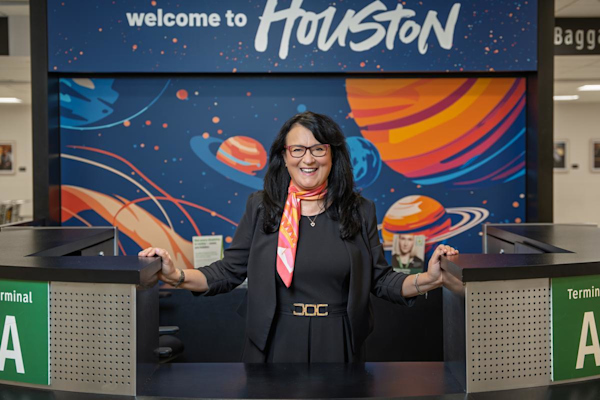 IAHHOUHASCommunityNov 23, 2026
Ella Ghica honored for bringing Houston hospitality to life
A traveler was struggling to find her way through a Houston airport when a student volunteer stepped forward. Instead of pointing down the terminal, he offered something better."I'm going to come with you, ma'am. I'm going to take you there myself."Ella Ghica, who oversees volunteer outreach initiatives for Houston Airports, has shared that encounter as an example of what exceptional service looks like. For Ghica, hospitality has never been simply about providing directions. It's about recognizing when someone needs help and taking the time to make a difference.That commitment earned Ghica one of Houston's most meaningful hospitality honors.Houston First named Ghica the recipient of the 2026 Ed King Service Award during its State of the Visitor Economy gathering at the Thompson Houston hotel in November. The annual award recognizes hospitality professionals whose dedication to service reflects the legacy of Ed King, a beloved figure in Houston's tourism industry.For Ghica, the recognition came at the end of an extraordinary year for Houston — one in which thousands of volunteers helped welcome the world for the FIFA World Cup.Ed King Jr. spent more than 25 years serving the City of Houston and Houston First as a client relations specialist. He was known for his warm smile, encouraging words and remarkable ability to make visitors feel less like guests and more like family.A mentor and ambassador for the city, King understood that a destination's reputation is built as much through personal encounters as through major attractions and international events.Following his death, Houston First established the Ed King Service Award to honor that philosophy. The inaugural recognition was presented posthumously to his family in 2024.The award recognizes hospitality professionals who go beyond the responsibilities of their jobs, demonstrating exceptional service, a commitment to visitors and a lasting impact on the people they serve.Those qualities are central to Ghica's work.Ghica joined the Houston Airports Volunteer Ambassador Program in March 2008, when it had just eight volunteers. She assumed responsibility for all volunteer outreach initiatives in September 2022, helping expand a program that had grown to 124 ambassadors across George Bush Intercontinental Airport (IAH) and William P. Hobby Airport (HOU) by early 2026.The volunteers guide travelers through terminals, answer questions, provide assistance to passengers with accessibility needs and offer reassurance when travel becomes overwhelming.In 2025 alone, Houston Airports volunteers contributed more than 14,200 hours of service.Their work took on greater significance in 2026.As Houston prepared to host seven FIFA World Cup matches, Ghica helped prepare airport volunteers to become ambassadors not only for the airports but for the city itself.More than 70 Houston Airports Volunteer Ambassadors completed Houston First's Houston Insider training, learning about local attractions, transportation, neighborhoods and cultural experiences so they could confidently assist international visitors.When the tournament arrived, volunteers became an important part of Houston's welcome.Across the city, the Houston World Cup Host Committee selected 4,190 volunteers, including 247 airport ambassadors. During the tournament travel period, Houston Airports Volunteer Ambassadors contributed 1,745 hours of customer service, while FIFA Host Committee volunteers provided another 7,200 hours of support at IAH and HOU.Behind those numbers were countless individual exchanges: a visitor finding the right transportation, a family getting help navigating an unfamiliar terminal or an international fan receiving a warm introduction to Houston.For Ghica, those interactions are the point.Through partnerships with Texas Southern University and a summer program for teenagers whose parents work for Houston Airports, she has helped introduce young people to aviation while teaching the value of serving others.Students gain hands-on experience inside working terminals, build communication skills and discover career possibilities they may never have considered.Some arrive hesitant to approach strangers. They leave with the confidence to offer help before being asked.Ghica has even shared her hope that one of those young volunteers might someday become an airport CEO.It's an ambitious dream rooted in a simple idea: an opportunity to serve can become an opportunity to lead."This recognition means more to me than words can ever express," Ghica said.Her motivation, she explained, has always been to make a difference through genuine hospitality, guided by a belief that "everyone matters."It's a fitting tribute to King, whose legacy reminds Houston's hospitality community that meaningful service is often found in the smallest gestures.And in a year when Houston welcomed the world, Ghica helped ensure that a simple offer of assistance could become something visitors remember long after their flights depart.Interested in becoming a Houston Airports Volunteer Ambassador? Click here to learn how to serve travelers, connect with your community and help deliver Houston-friendly hospitality.Read more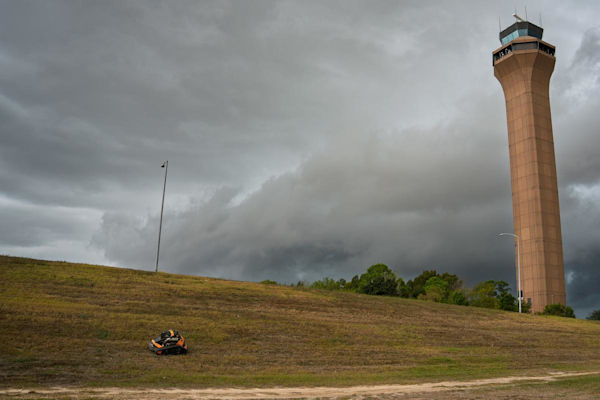 IAHNov 3, 2026
IAH takes airport mowing high-tech
At George Bush Intercontinental Airport (IAH), some of the most challenging landscaping jobs are on the steep, grassy embankments surrounding airport roadways and infrastructure.For Houston Airports Maintenance crews, mowing those slopes has traditionally meant navigating uneven terrain with heavy equipment, where a sudden slide or rollover could cause serious injury.Now, a new machine is changing where employees need to be to get the job done.Houston Airports has introduced its first Energreen RoboECO, a compact, remote-controlled mower designed to tackle steep terrain while allowing employees to operate it from safer ground."Our maintenance teams work in challenging environments every day, and their safety has to come first," said Cliff Price, general manager of Bush Airport for Houston Airports. "This equipment allows us to tackle some of our most difficult mowing jobs without putting an employee directly on a steep slope. That's a meaningful improvement in how we protect our people."Unlike traditional riding mowers, the RoboECO has no driver's seat. Instead, an employee operates it using a handheld remote control. The mower travels on rubber tracks rather than wheels, helping it maintain traction on uneven ground. Its low profile and specialized track system are designed to provide stability on steep inclines.According to manufacturer Energreen America, the RoboECO can operate on slopes of up to 61 degrees and features a 40-inch cutting deck. Its remote control has a maximum operating range of approximately 490 feet, although actual working distances depend on conditions and safety requirements.The mower is not autonomous. A trained employee remains responsible for controlling its movements, monitoring conditions and operating the cutting equipment.While the RoboECO cuts grass at a pace comparable to conventional equipment, its primary advantage is reducing the need for employees to operate heavy machinery on steep embankments.Houston Airports currently has one RoboECO at IAH, where Maintenance employees are receiving hands-on training and evaluating its performance. The team will assess its handling, cutting effectiveness and suitability for different slopes before determining whether to invest in additional units."We're approaching this as both a safety investment and an opportunity to improve how we maintain the airport," Price said. "Our employees are the ones who understand these conditions best. Their experience operating the mower will help us determine where this technology makes sense and whether we should expand its use."Read more
