
Welcome toGeorge Bush Intercontinental Airport
Check parking availability
Reserve your parking in advance and save up to 50%.Learn moreGet through security faster
Check security wait times to make sure you will get through security with ease!Security Wait TimesPlan your ride from the airport
Find ground transportation options including bus routes, car rentals, rideshare apps, shuttles, and more.Ground Transportation


Good to know
Airport Services
IAH provides a variety of service-oriented amenities to enhance your travel experience.
Good to knowQuick links
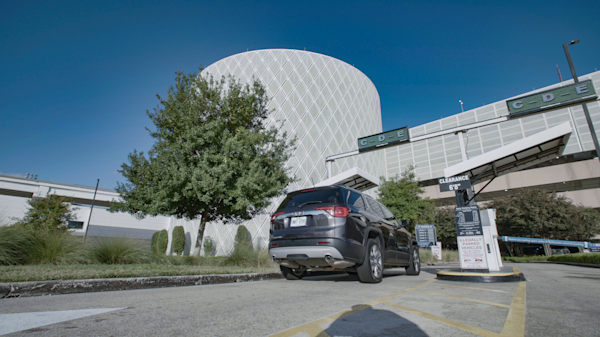
IAH Parking Information
Convenient parking is available, including reserved spots, EV charging, and accessible spaces.
Learn more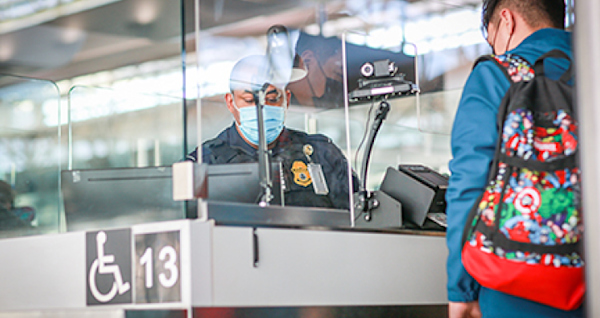
International Processing
International passengers will proceed through Customs & Immigration in the Terminal E international arrivals hall.
Learn more
Need Transportation
Choose from Rideshare apps, shuttles, or rental cars for convenient ground transportation options.
Learn more
Latest UpdatesNewsroom
View all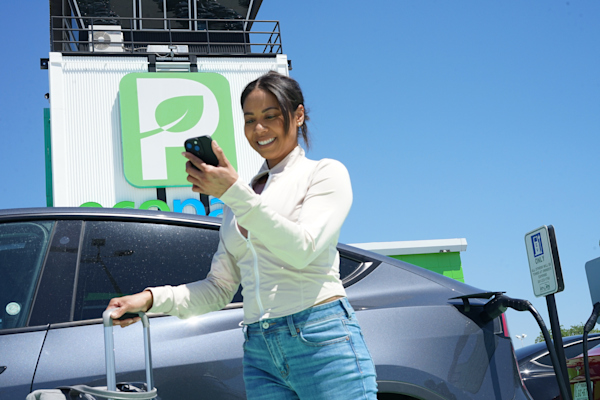 IAHHOUAmenitiesHASOct 8, 2026
Find EV charging at ecopark before flying from IAH or HOU
Travelers who want to charge an electric vehicle while flying from Houston's airports should plan to park at ecopark. Choosing the right lot before leaving home helps drivers head straight to the charging location.Where to plug inAt IAH, travelers can find EV charging at:- ecopark on John F. Kennedy Boulevard- ecopark2 on Will Clayton Parkway. A parking reservation is required for entry.At HOU, EV charging is available at the airport’s ecopark lot.Before traveling, visit the airport’s parking page for lot details, directions and reservations.Electric vehicles behind the scenesThe commitment to electric vehicles extends beyond passenger parking.Houston Airports has 57 electric vehicles in its fleet — nearly 60 trucks and vans supporting the work that keeps its airports running. In May, the system added 32 electric vehicles to replace gas-powered vehicles across IAH, HOU and Ellington Airport (EFD)/Houston Spaceport.The additions include Ford F-150 Lightning trucks and Ford E-Transit utility vans for teams handling maintenance, information technology and other airport operations. Replacing gas-powered work vehicles with electric models reduces tailpipe emissions from those daily trips.Progress in reducing emissionsFleet electrification is one part of the airport system's work to reduce its carbon footprint. Other investments include LED lighting, more efficient energy systems and a solar canopy that generates electricity for Hobby Airport operations.In September, Houston Airports reported a 23% systemwide reduction in carbon emissions from its 2019 baseline. From 2019 to 2024, emissions fell 31% at IAH, 28% at HOU and 11% at EFD.All three airports achieved Level 3 in Airports Council International’s Airport Carbon Accreditation program in 2025 and were renewed at Level 3 in 2026. That level expands the work to include collaboration with airlines and other airport partners on managing emissions.Read more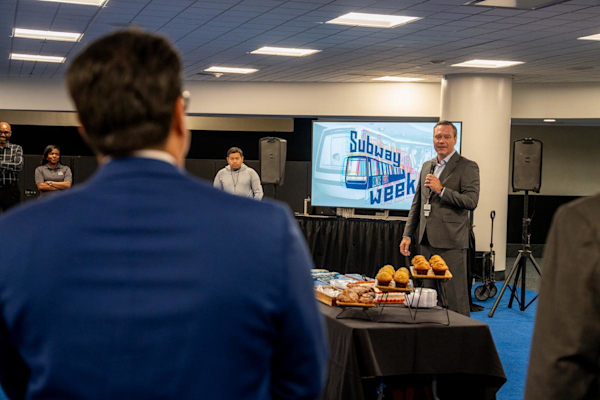 IAHAug 25, 2026
The IAH Subway gets its moment at 45
For 45 years, the IAH Subway has lived beneath George Bush Intercontinental Airport, moving millions with the quiet consistency of a machine designed to disappear into the trip.Then, on a Wednesday morning in August, it became the destination.At the Terminal D/E Subway station, a birthday cake, commemorative baby blue socks and stacks of trading cards covered nearby tables. Houston Airports employees gathered beneath the low tunnel ceiling as travelers paused to see why the airport’s underground train was having a party.The Aug. 19 celebration anchored the first-ever IAH Subway Week, Aug. 17–21, marking the system’s 45th anniversary.Houston Airports Director of Aviation Jim Szczesniak called the Subway “the quirky thing about IAH.”The description fits. Its compact cars move at a measured pace along a two-mile underground circuit connecting Terminals A, B, C and D/E with the Houston Airport Marriott before security. A complete loop takes about 19 minutes.The IAH Subway is also living transportation history.Houston selected the WEDway PeopleMover in 1979. Designed by WED Enterprises, Disney’s design and engineering organization, the $14.5 million electric system brought technology developed for Tomorrowland into the daily operation of a growing public airport.LEARN MORE | IAH Subway HistoryWhen the WEDway opened Aug. 17, 1981, Mickey Mouse and Donald Duck joined Houston Mayor Jim McConn for the dedication. As IAH expanded, so did its Subway. It remains the only transportation system Disney ever designed and built for a public or private entity.In 2025, the IAH Subway carried more than 3.3 million passengers and recorded a 99.76% reliability. Szczesniak used the anniversary to thank the employees behind that performance, shifting attention from the system’s famous origin to the people responsible for its longevity.The IAH Subway is managed within the Houston Airports Infrastructure Division, led by Chief Infrastructure Officer Scott Hill. Terrance York, senior division manager, oversees the group responsible for the Subway, contracts and fleet services. Elesa M. Rodriquez serves as senior project manager for the Skyway and Subway.Throughout IAH Subway Week, displays and public-address announcements traced the system’s 1981 opening, its Disney connection, its engineering and its appearances in popular culture. Trading cards turned archival photographs into keepsakes, while a dedicated webpage extended the experience with historical photos, video and operating information.Airports are often measured by what is new — terminals, technology, routes and records. The IAH Subway represents another kind of achievement: a system that adapted as Bush Airport grew and still serves passengers decades after the future it once represented became the past.Read more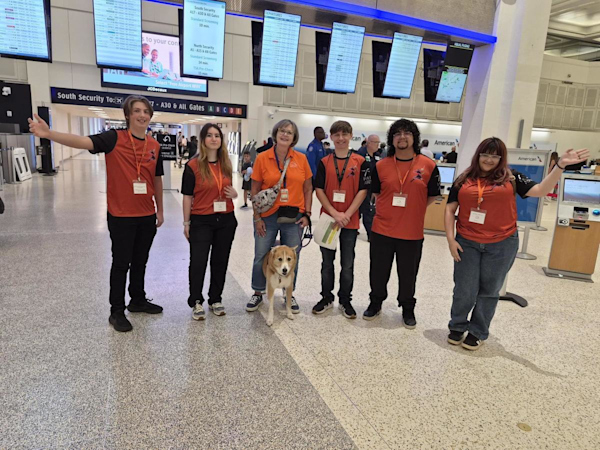 IAHHOUCommunityAug 19, 2026
Two emails, four words: Teens find their voices at Houston Airports
On a Tuesday morning in August, Ella Ghica sent a thank-you note to the families of teenagers who had spent their summer helping passengers at Houston’s airports. A few hours later, one parent wrote back.In her note, Ghica described what she witnessed in the terminals. In his reply, Jerrold Sarmiento described what he saw after his daughter came home.Read together, the emails reveal what can happen when communication moves off a screen and into public life.At the center are four words: “May I help you?”“For many of the teens, approaching a passenger who appeared lost or needed assistance was challenging at first,” wrote Ghica, manager of outreach initiatives for the volunteer programs at George Bush Intercontinental Airport and William P. Hobby Airport. “It takes confidence to walk up to someone and ask, ‘May I help you?’”In 2026, teenagers have not forgotten how to talk. They have simply grown up with time between thought and response. On a phone, tablet or computer, a message can be drafted and revised. Even a sent text can be edited. There is time to shape the response and the image it projects. Face-to-face conversation in an airport terminal offers no such buffer.The need for help does not arrive as a smartphone notification. The teen volunteer has to recognize it and answer without rehearsal.The Houston Airports Teen Volunteer Program, now in its second summer, is open to teenagers whose parents work for Houston Airports. Ghica’s email makes clear that confidence was not a prerequisite. It turned out to be one of the program’s results. “After spending time in the terminals and gaining experience, we watched their confidence grow,” Ghica wrote. “Seeing that transformation was one of the most rewarding parts of the program.”The teenagers were learning customer service, but they were also learning how to enter a moment that did not belong to them. Someone else was lost. Someone else was worried. To help, they had to turn their attention outward and speak first with enough assurance to put a traveler at ease. By the end of the summer, Ghica saw teenagers who had once hesitated become part of the daily rhythm of the airport.“Your teens not only helped our passengers — they became a valued part of our airport family,” she wrote.Sarmiento recognized the change Ghica described because he had been watching it from the other side.A Houston Airports employee whose daughter participated in the program, Sarmiento saw what no airport supervisor could: the stories she carried through the front door.“She came home with so many positive stories about helping passengers,” he wrote.LEARN MORE: Volunteer with Houston AirportsThose stories were evidence of something deeper. His daughter was not merely recounting how she had spent her day. She was describing moments when she approached someone she did not know and became the person who could help.“I could also see how the experience helped her become more confident in communicating with others and stepping outside of her comfort zone,” Sarmiento wrote.His reply adds something an institutional thank-you note cannot: a parent’s knowledge of who a child was before the summer and what had begun to shift.“It was much more than simply volunteering,” he wrote.The program gave his daughter, Sarmiento said, “a greater understanding of what it means to serve others.”Their two perspectives explain why a teen volunteer program matters at a moment when adolescence and air travel are increasingly mediated by technology.A phone can guide a passenger to a gate. It cannot always recognize when someone is too uncertain to ask for help.For the teenagers, the work required a different kind of attention. They had to watch the people in front of them.That is a practical skill learned in public, one passenger at a time.Ghica saw it in the terminals. Sarmiento saw it at home.“We are very grateful to you and everyone at Houston Airports who welcomed, encouraged and guided the teens throughout the summer,” he wrote. “She will carry the lessons and memories from this summer with her for years to come.”Next summer, when a teen volunteer asks, “May I help you?” those four words may help a passenger find their way — and a young person find their voice.Read more
